This digital guide can be used with the printable checklist version of Pearl's Buyer Guide. If you are in the home and able to access the home's water heater, click here to access the checklist so you can write down key features of the water heater.
Two water heaters in the home?
Some homes have more than one unit — sometimes in different locations, sometimes serving different parts of the house. If the home has multiple water heaters, work through this guide once per unit.
This guide helps you:
- Identify the water heater
- Find the nameplate
- Find the EnergyGuide label
- Check the other features
- Understand your SCORE
Identify the water heater
Before you can evaluate a water heater, you need to know what type it is. The answers to these questions determine the fuel source, the vent setup, and which efficiency standards apply.
Storage tank or tankless?
The most visible difference is shape. A storage water heater is a large cylinder — usually 4 to 5 feet tall — standing on the floor. It heats water and keeps it hot until it is needed. A tankless water heater is a flat box mounted on a wall. It heats water on demand only. Both types can be electric or gas.
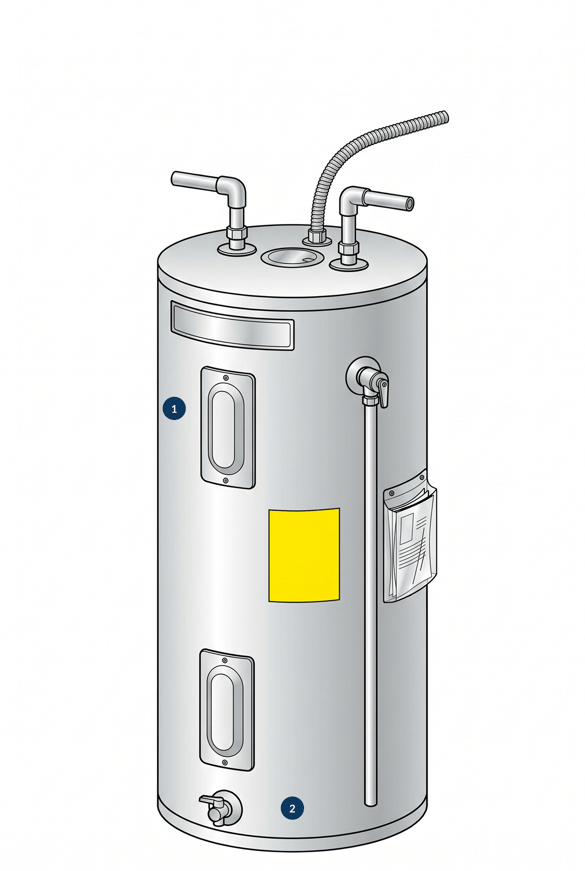
|
Caption: |
|
1. Holds 30–80 gallons of hot water, ready on demand |
|
2. Continuously reheats to the water heater's temperature setting— even when no hot water is being used |
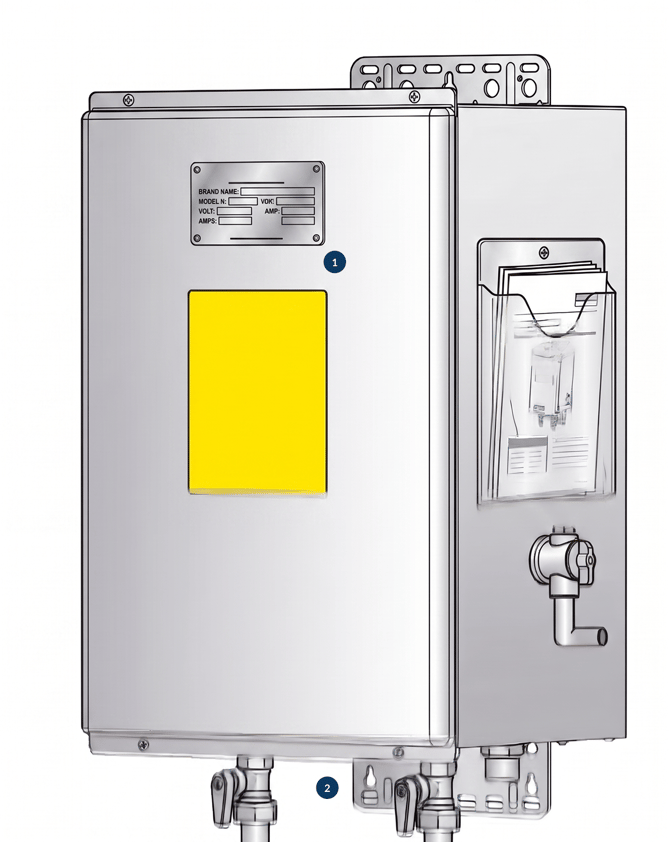
|
Caption: 1. No tank — heats water on demand only when a tap is turned on 2. Cold water enters, passes through the heat exchanger, and exits as hot water — no stored supply |
What fuel does it use?
The clearest way to identify fuel type is to look for three things:
- Look at the connections. Electric units have thick electrical cables or conduit at the top or side. Gas, oil, and propane units have a pipe with a shutoff valve — the fuel supply line.
- Look for a flue. Electric units have no exhaust vent. A metal pipe leading up through the ceiling, or PVC pipes going out through the wall, means a combustion fuel: gas, oil, or propane.
- Check the nameplate. The label on the unit will often list the fuel type directly.
For tankless units, the same logic applies:
-
electrical conduit only means electric;
-
a gas supply pipe plus vent pipes means gas.
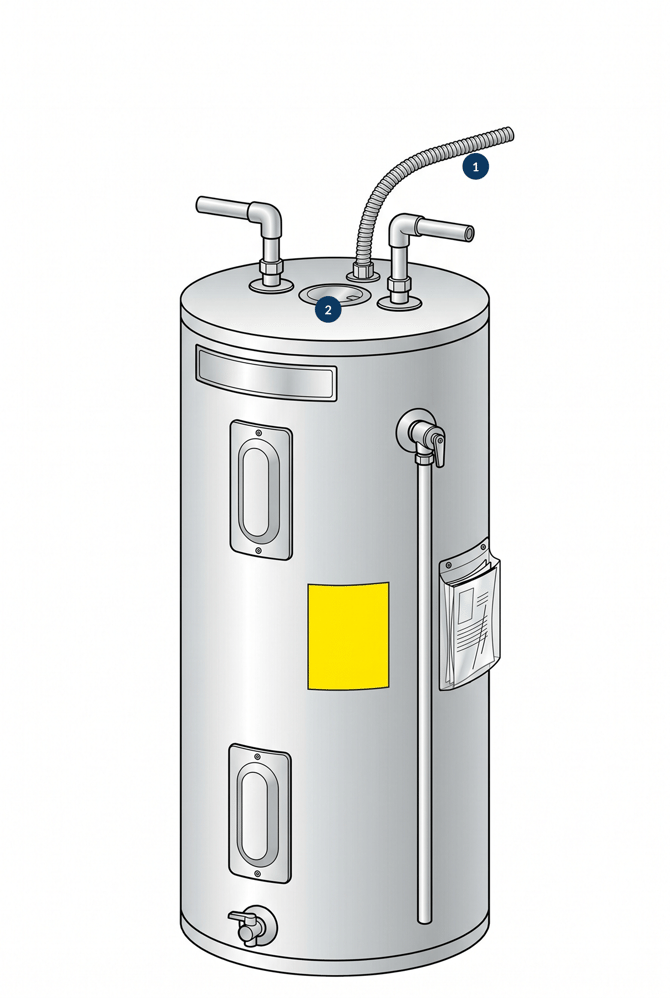
|
Caption: 1. Electrical conduit supplies power. No fuel lines for gas, oil, or propane. 2. No burning of fuels. No flue needed to remove combustion gases. |
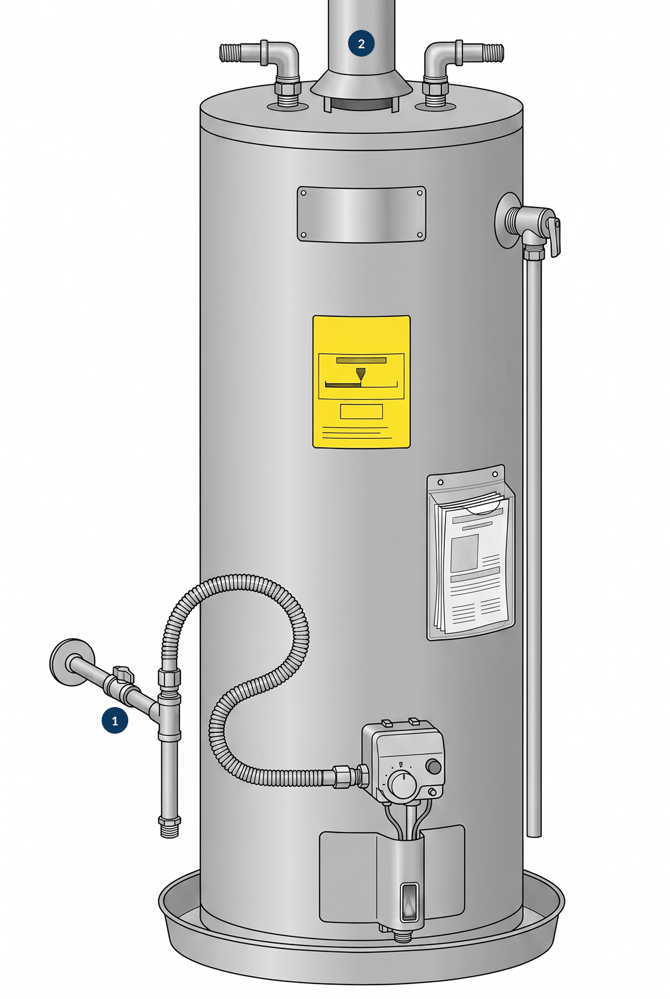
|
Caption: 1. Fuel line from natural gas utility provider or an oil or propane line from an oil or propane fuel tank. 2. Exhaust flue — gas, oil, or propane units always have a venting system to remove harmful gases from the fuel burning process. |
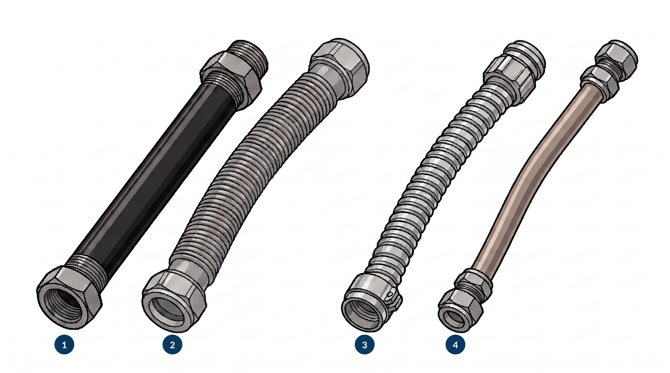
|
Caption: 1. Black iron pipe — rigid black steel; standard for natural gas main supply lines 2. Flexible stainless steel tubing; natural gas or propane gas connector, often with a yellow or gray jacket and a shutoff valve 3. Flexible metallic conduit. Looks similar to a flexible gas line, but this is conduit that protects an electrical line that powers the water heater. Not gas; no shutoff valve. 4. Copper tubing — smooth, small-diameter tube used for oil supply lines |
Electric — standard or heat pump?
If there is no vent pipe, look at the top of the unit.
- Plain top, no extra components → standard electric storage water heater
- Large unit on top with a fan or air intake → heat pump water heater. It runs on electricity but pulls heat from the surrounding air — similar to how a refrigerator works, but in reverse. Heat pump water heaters are significantly taller than standard electric units.
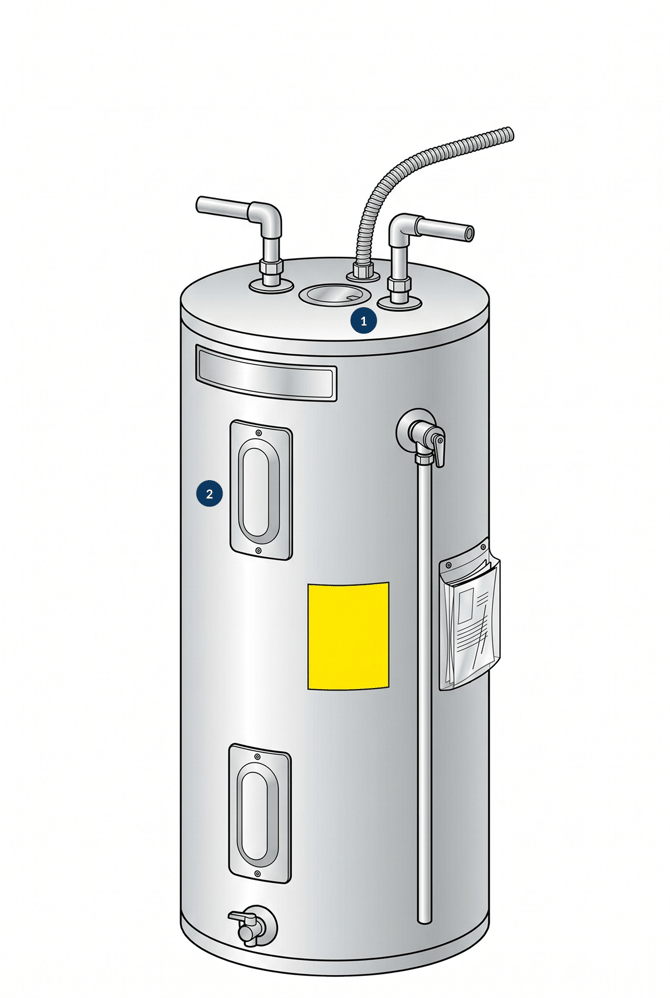
|
Caption: 1. No heat pump unit — heating elements inside the tank do all the work 2. Electric heating elements are housed behind these panels |
.png?width=670&height=998&name=Heat%20Pump%20Water%20Heater%20(HPWH).png)
|
Caption: 1. Heat pump unit — extracts warmth from surrounding air to heat water instead of using electric coils 2. Same storage tank underneath — but uses 3-5x less electricity than a standard electric model. Most include backup heating elements that kick in during periods of high demand. |
Combustion — what type of vent?
If the unit uses gas, oil, or propane, the next step is to identify the vent type. Vent type affects how combustion gases leave the home — and how safely.
Typical. Hot combustion gases rise naturally through a metal flue pipe and exit through the roof or an exterior wall. This is the most common setup in older homes.
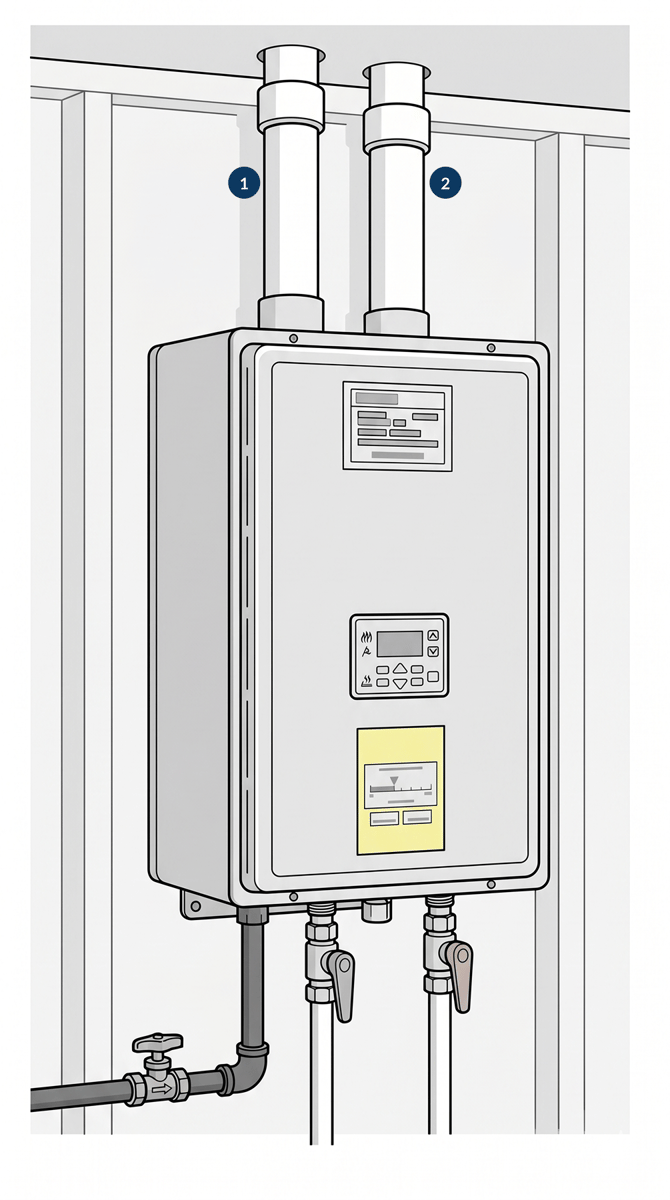
Power vent. A fan pushes combustion gases through a horizontal vent pipe to the outside. The exhaust pipe is usually a white plastic PVC pipe.
Sealed combustion. The burner draws outside air through a dedicated intake pipe, and exhaust exits through a separate pipe. The home's air is never used in the combustion process. This is the safest type.
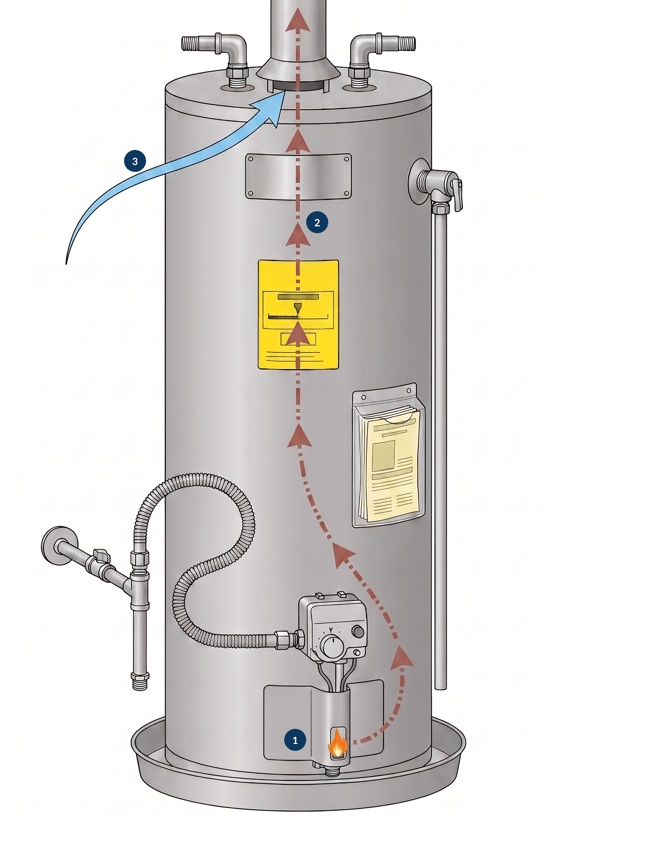
|
Caption: 1. Burner — where fuel ignites to heat the water |
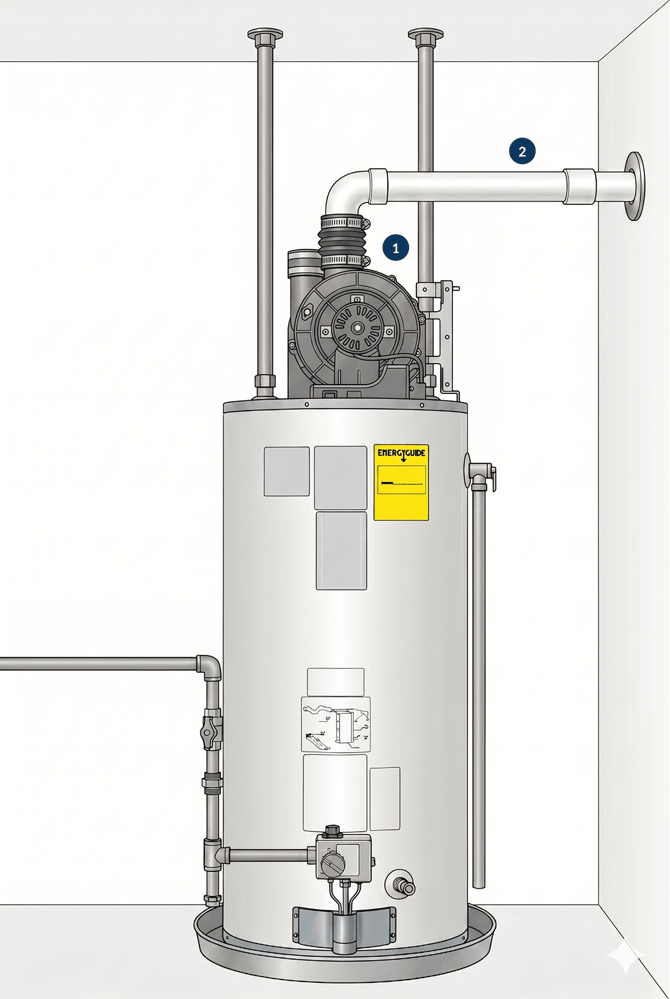
|
Caption: 1. Blower motor — forces exhaust gases out through the pipe; no natural draft required, but air from the home gets sucked into the vent 2. PVC exhaust pipe — white plastic vent that can exit horizontally through a wall, or just straight up |
|
Caption: 1. Combustion air intake — pulls fresh air in directly from outside. 2. Exhaust pipe — combustion gases vented outside; both pipes keep the process fully sealed from your living space. Both pipes could be vertical or horizontal. |
Gas tankless water heaters are almost always sealed combustion. True atmospheric or power-vented tankless units don't exist — those vent styles are found only on storage tank water heaters.
Storage water heaters with sealed combustion exist but are uncommon.
Not sure what you're looking at?
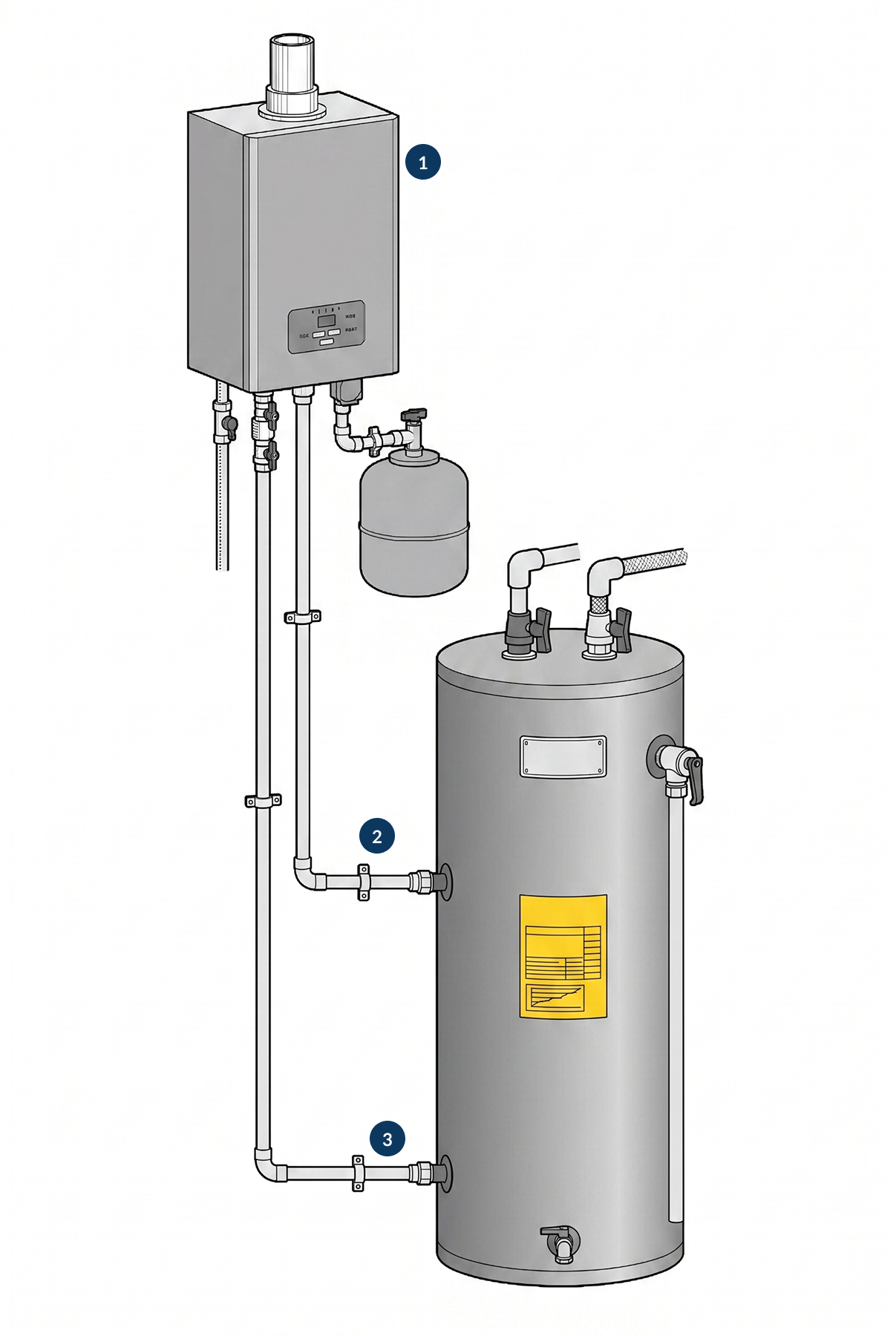
Some setups are more complex — including water heaters connected to a boiler, a ground-source heat pump, or solar collectors. A tankless water heater can also look similar to a wall-mounted boiler. If the piping looks unusual or you can't identify the type, ask your home inspector. You can also contact our team for help.
| Caption: |
| 1. Heat source connection — in most homes, this is a boiler that also heats the living space. Solar thermal collectors and ground source heat pumps (GSHPs) can serve the same role. |
| 2. Supply line — hot fluid from the heat source enters here and transfers heat to the tank through an internal coil |
| 3. Return line — cooled fluid exits here and loops back to the heat source to be reheated |
Find the nameplate
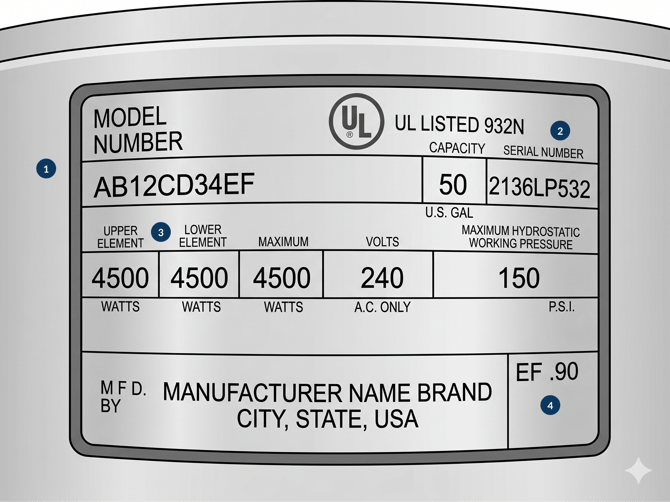
The nameplate is a label affixed directly to the unit. It has the information you need to determine age, look up efficiency, and check warranty status.
Where to find it
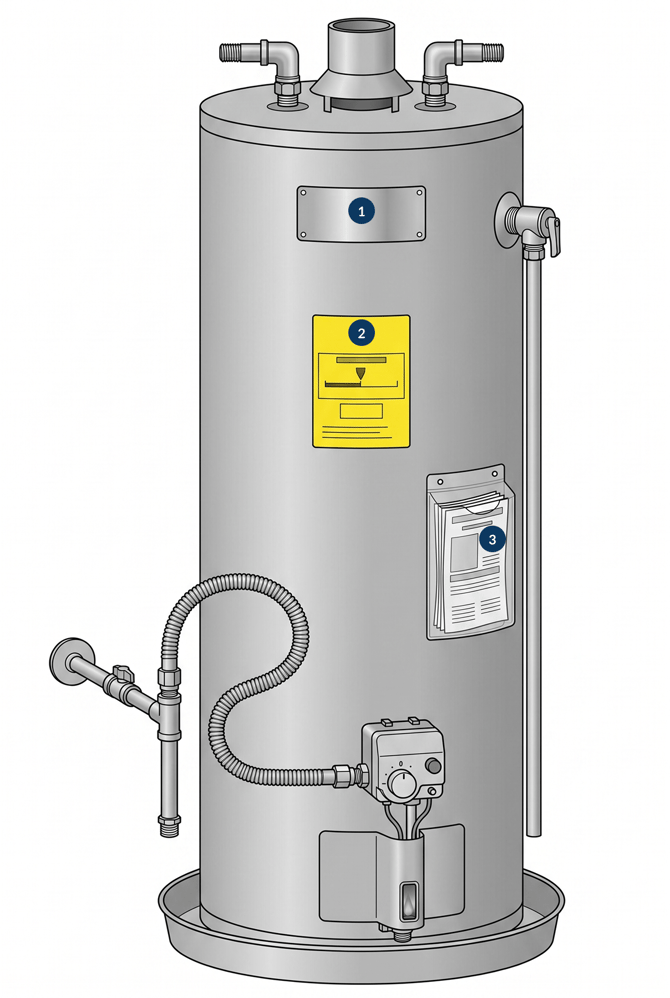
On a storage tank, look on the upper third of the tank — usually at eye level or just below. On a tankless unit, it may be on the front, inside a panel door, or on the back of the unit.
|
Caption: 1. Model number — when combined with manufacturer name, Uniform Energy Factor (UEF) and other specifications can be found online 2. Serial number — often encodes the manufacture date; this tells you how old the unit is 3. Input rating — electric units show wattage; gas units show BTU input. Either way, this tells you how much energy the unit consumes and also confirms whether the system is electric (watts) or uses a combustion fuel (BTU). 4. Uniform Energy Factor (UEF) or Energy Factor (EF) — the efficiency rating; higher is better. Most nameplates do not display this information and it needs to be found elsewhere. |
What to record
Five fields matter most:
- Uniform Energy Factor (UEF) or Energy Factor (EF) — the efficiency rating; higher is better. Most nameplates do not display this information and it needs to be found elsewhere.
- Brand — the manufacturer name (e.g., Rheem, Bradford White, A.O. Smith)
- Model number — used to look up specifications, UEF, and warranty details
- Serial number — used to determine the manufactured date (see below)
- Manufactured date — if listed separately from the serial number
How to decode a serial number
Most manufacturers encode the date of manufacture in the first few characters of the serial number. The format varies by brand. Common patterns include:
- First four digits as year and week (e.g., 2318… → manufactured in week 18 of 2023)
- A letter followed by a two-digit year (e.g., F18… → manufactured in 2018; the letter encodes the month)
Pearl's digital guide includes a decoder for major brands. If the serial number alone isn't enough, the model number lookup through the Automated Virtual Assistant (see the EnergyGuide section below) can also return the manufactured date.
Estimating lifespan
System life varies by type, water quality, and maintenance history. Typical ranges:
- Storage tank (electric or gas): 10–15 years
- Tankless: 15–20 years
- Heat pump: 10–15 years
These are general ranges. A unit with documented annual maintenance may reasonably exceed them. A unit in a hard-water area with no maintenance history may fall short.
Find the EnergyGuide label
The EnergyGuide label is a large yellow label required on most new water heaters sold in the United States. It shows the unit's estimated annual energy cost and efficiency rating.
Where to find it
Look on the front or side. On older units or units installed in tight spaces, the label may have been removed or covered. Some units also have pouches where multiple documents can be stored, such as the User Manual, maintenance guide, EnergyGuide label, installation instructions and warranty information.
| Caption: |
| 1. Nameplate — a small metal or foil label, usually near the top of the tank. Has model number, serial number, fuel type, and input rating |
| 2. EnergyGuide label — the large yellow label on the front or side of the unit. May be removed or covered on older units |
| 3. Document pouch — a plastic sleeve that may hold the user manual, installation instructions, warranty, and EnergyGuide label. Not present on all units |
What's on the EnergyGuide Label
.png?width=670&height=911&name=EnergyGuide%20Label%20(1).png)
|
Caption: 1. Fuel type and product type — "similar models" in the cost comparison are limited to the same fuel type AND the same first hour rating tier. You cannot use EnergyGuide to compare gas vs. electric operating costs directly from the label 2. Manufacturer brand and model — cross-check these against the nameplate on the unit. If they don't match, the label may belong to a different model 3. Estimated yearly energy cost — based on national average utility rates (see ④ for assumptions). The comparison range can include very different technologies: for example, an electric heat pump and an electric resistance tank with the same first hour rating tier will appear on the same scale 4. Usage assumptions — these bullets show the utility rate, usage, and annual energy consumption used to calculate the cost estimate. If your utility rate is higher or lower than the national average shown, your real cost will differ 5. If a water heater has earned the ENERGY STAR label, the mark will often appear here. |
What is UEF?
UEF stands for Uniform Energy Factor. It is the U.S. standard for measuring water heater efficiency. A higher UEF means the unit produces more hot water per unit of energy it consumes. A heat pump water heater with a UEF of 3.5 uses about 70% less energy than a standard electric unit with a UEF of 0.95 — often a difference of hundreds of dollars per year.
How to interpret your UEF
UEF thresholds differ for electric and combustion systems because the energy sources are not directly comparable. Use the table below to find your rating:
|
|
Excellent |
Very Good |
Good |
Typical |
|
⚡ Electric |
3.2+ |
2.0–3.2 |
1.0–2.0 |
< 1.0 |
|
🔥 Gas / Oil / Propane |
0.88+ |
0.70–0.87 |
0.58–0.69 |
< 0.58 |
What if there's no label?
You can look up UEF by model number. Two options:
- Pearl's Automated Virtual Assistant — call 800-888-8888. Have the manufacturer name and model number ready. We need both.
- AHRI Directory ahridirectory.org — search by manufacturer and model number.
Need help finding UEF?
Call Pearl's Automated Virtual Assistant: 800-888-8888. Have the manufacturer name and model number ready — we need both.
Check the other features
Beyond type and efficiency, a few other characteristics affect the Pearl SCORE and the system's overall value to the household.
ENERGY STAR certification
ENERGY STAR is a voluntary certification program run by the EPA. For water heaters, it marks units that significantly exceed federal minimum efficiency standards. Heat pump water heaters almost universally qualify. Most standard electric and conventional gas tank units do not.
Look for the ENERGY STAR label on the unit itself or on the EnergyGuide label. You can also verify at energystar.gov using the model number.
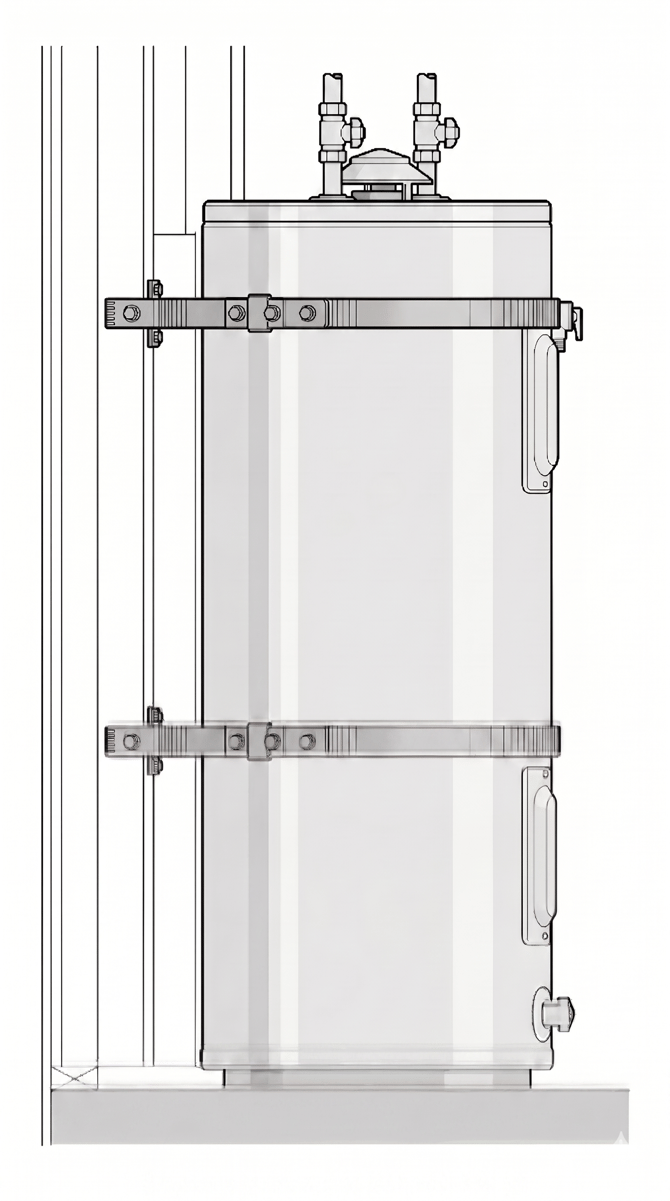
Is the tank firmly strapped?
A storage tank that is firmly strapped to a wall stud or masonry surface can resist tipping in earthquakes and flooding events. An unstrapped tank can fall, rupture supply lines, and cause significant water and structural damage.
Look for metal straps or brackets securing the tank — typically in two places: upper third and lower third. Strapping is required by code in seismic zones (including all of California) and is good practice everywhere.
|
Caption: |
Installation date
The installation date is different from the manufactured date. A unit may have been built in 2018 but installed in 2021. The installation date is what starts the warranty clock and the useful life estimate.
Installation date is most reliably found in seller documents: the purchase receipt, warranty registration card, or service records. Ask the seller for these documents before the inspection. If none are available, the manufactured date is a reasonable fallback.
Smart and connected features
Some newer water heaters include features that can reduce operating costs over time:
- Smart thermostat compatibility — connects to a smart home system to schedule heating during off-peak hours, when electricity rates are lower
- Leak sensor — detects water at the base of the unit and can alert you before damage spreads
- Remote monitoring and app control — lets you adjust settings or check status from your phone
These features don't change the UEF rating, but they can meaningfully reduce long-term energy costs for households that use them.
Understand your SCORE
Pearl evaluates water heaters across five dimensions. Here's what each one measures and how to read your results.
S — Safety
Safety reflects the risk of combustion gas exposure based on vent type. Electric systems have no combustion process, so they carry the lowest risk. For combustion systems, the vent type determines how reliably exhaust gases are kept out of the home.
|
Vent type |
Safety rating |
|
Electric (no combustion) |
Excellent |
|
Sealed combustion |
Very Good |
|
Power vent |
Good |
|
Typical flue |
Typical |
O — Operating Cost
Operating cost reflects how efficiently the system produces hot water, as measured by UEF. The higher the UEF, the less energy the unit consumes for the same output.
A heat pump water heater with a UEF of 3.5 uses roughly 70% less energy than a standard electric unit with a UEF of 0.95. Over a 10-year period, that difference often represents $3,000–$5,000 in utility costs, depending on electricity rates and usage.
Use the table in the EnergyGuide section above to look up your operating cost rating.
R — Resilience
Resilience reflects how well the system is protected from physical hazards. Two factors matter:
Strapping — a tank firmly strapped to the wall resists tipping in earthquakes and flooding events. This is the single most effective physical protection measure for a storage water heater.
Elevation — in flood-prone areas, raising the unit above the base flood elevation (BFE) prevents water damage during a flood event and may be required by local building code. Even outside flood zones, a unit elevated above floor level has a practical buffer against minor water intrusion.
E — Energy
Energy reflects whether the system is optimized for efficient operation. ENERGY STAR certification and smart control features are the key indicators.
A certified heat pump water heater with smart scheduling can shift water heating to off-peak hours — reducing both operating costs and grid demand. This is especially valuable in households on time-of-use electricity rates, where the price difference between peak and off-peak hours can be substantial.
Age
Age isn't a performance score — it's context. A system in its early life is a different proposition than one approaching the end of its expected lifespan, even if both have the same UEF.
Determine age by installation date if available. If not, use manufactured date.
- Early life — typically full useful life remaining; standard maintenance applies
- Mid-life — plan ahead for replacement; watch for early signs of wear (corrosion, inconsistent temperatures, unusual sounds)
- Later life — replacement is likely in the near term; evaluate repair vs. replace carefully
Maintenance records matter here. A well-maintained system in later life may outlast an identical unit with no maintenance history.